
The Source Principle
The authoritative source remains the source of truth throughout the lifecycle.
An emerging engineering discipline
Building Trustworthy Software from Human Policy
Policy Engineering is the discipline concerned with transforming legislation, regulations, contracts, standards, and enterprise policies into trustworthy, testable, explainable, and deterministic software.
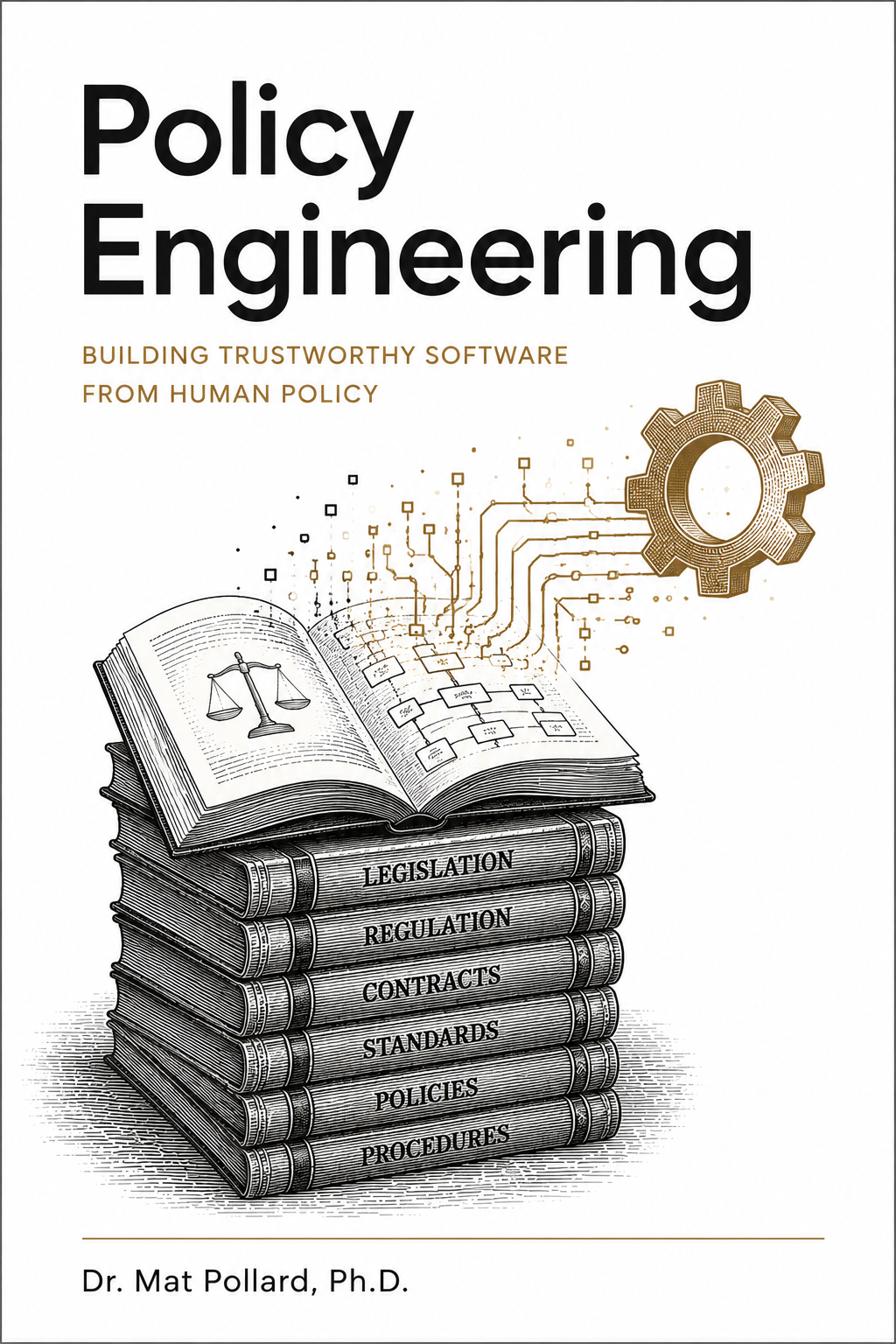
The foundational book
The book introduces the principles, lifecycle, vocabulary, and technologies required to transform human policy into dependable software.
Watch
The umbrella definition
A policy is an authoritative expression of intent that governs decisions, actions, obligations, permissions, classifications, or calculations within a defined context.
Policy is much broader than an internal dress code or acceptable-use document. It includes any authoritative source that determines what should happen in a particular situation.
Throughout this discipline, the term encompasses legislation, regulation, contracts, standards, clinical guidance, underwriting manuals, pricing schedules, security controls, tax codes, operating procedures, and internal business policy.
Why now?
Organizations already treat software, data, and infrastructure as engineered assets. Policy governs the behavior of all three, yet it is still commonly managed as documents, spreadsheets, hand-maintained rules, and institutional memory.
Artificial intelligence has reduced the cost of translating human policy into executable logic. That does not eliminate engineering; it changes where the discipline is needed. The central challenge is no longer merely producing an implementation, but proving that it faithfully represents authoritative intent.
Policy Engineering provides a systematic approach to ambiguity, contradiction, provenance, testing, determinism, lifecycle management, and change.
Foundational ideas
The authoritative source remains the source of truth throughout the lifecycle.
Executable policy is compiled from authoritative sources rather than independently authored.
Every outcome should be traceable to the requirements and source passages that governed it.
Repeatable policy decisions should execute deterministically, even when AI assists with their creation.
Policy implementations should be tested against explicit requirements, boundaries, and scenarios.
When policy changes, affected implementations should be regenerated instead of manually patched.
Ambiguity, contradiction, incompleteness, and hidden assumptions should be exposed before deployment.
A disciplined transformation
Authoritative human policy becomes governed executable software through a repeatable sequence of analysis, verification, compilation, testing, and controlled release.
Collect the authoritative documents governing the domain.
Identify decisions, calculations, classifications, obligations, and permitted actions.
Define inputs, outputs, expected behavior, and acceptance criteria.
Establish boundaries, dependencies, structure, and execution semantics.
Transform approved requirements into deterministic executable policy.
Verify positive, negative, boundary, conflict, and evidence scenarios.
Release a versioned, governed artifact for operational consumption.
Execute policy with deterministic outcomes, explanations, and traceability.
Engineering rigor
Ambiguous terminology, contradictory clauses, missing edge cases, hidden precedence, and undocumented exceptions are structural defects. Policy Engineering brings those defects into view before they become operational failures.
Policy Engineering, in production
The discipline is open. Making it real at enterprise scale is what Sertainly does.
Sertainly is the first — and today the only — platform built end to end on Policy Engineering. It compiles authoritative policy into deterministic, traceable decision infrastructure: analysed, verified, versioned, and explainable by construction.
Everything this discipline describes — source-first compilation, provenance, a deterministic runtime, structural analysis, and regeneration — Sertainly makes operational, so your applications, workflows, and AI agents consult one governed source of decisions.
An open discipline
Policy Engineering should not belong to a single company, product, or technology. It needs an open body of knowledge shaped by practitioners across policy, law, compliance, software, architecture, AI, academia, government, and standards.
Principles, practices, roles, patterns, anti-patterns, and terminology.
A canonical model from authoritative source material to governed execution.
Interoperable representations for executable policy, requirements, traces, and packages.
A way to assess how effectively organizations govern and operationalize policy.
Learning resources for practitioners at the intersection of policy, software, governance, and AI.
Evidence showing how the discipline improves consistency, auditability, change, and trust.
The conversation starts here
The time has come to engineer it. Join the emerging community and help shape the principles, practices, and standards of Policy Engineering.